The quietest time of day to go
Seventeen departures a day, and they are not equal. Where the coach traffic sits, why the first and last slots are calmer, and what a quiet tour actually changes.
 Written with Hemi Williams, Waitomo cave guide and local specialist, guiding since 2015
The tour costs the same at nine in the morning and half past twelve. What differs is how many people are standing between you and the ceiling, and whether the boat you are on feels like a private moment or a queue that happens to be floating.
What is the quietest time to visit the Waitomo caves?
The first departures of the morning and the last of the afternoon. Tours leave every 30 minutes from 9am to 5pm, giving seventeen slots, and coach traffic clusters in the middle of the day. Travellers report groups of around 23 people with tours running back to back through the busy hours.
That group figure is reported rather than published by the operator. What is published is the schedule, and it tells you the same thing: a site handling up to 500,000 visitors a year with a departure every half hour is designed for throughput, and throughput has a peak.
| Slot | Typical feel | Why |
|---|---|---|
| 9:00 to 10:00 | Quietest | Coaches have not arrived; independent drivers still en route |
| 10:00 to 12:00 | Building | Auckland and Rotorua arrivals land |
| 12:00 to 15:00 | Busiest | Coach day trips work to a lunchtime rhythm |
| 15:00 to 17:00 | Easing, then quiet | Day trips heading back; last slots often calm |
Why does the middle of the day fill up?
Because the drive times all converge there. Auckland is 202 kilometres and two and a half hours away, Rotorua 147 kilometres and two hours, Hamilton 71 kilometres and one, on the operator's published driving times. Leave any of those after breakfast and you arrive between eleven and one.
Coach day trips make it sharper. A tour operator running Auckland to Waitomo to Hobbiton has to be at the caves in the late morning to make the rest of the day work, and several of them are doing the same arithmetic. The result is a predictable bulge in the middle of the schedule that has nothing to do with the cave and everything to do with the roads.
The corollary is useful. Anyone willing to leave early, or to stay the night nearby, gets a materially different tour for the same ticket. Where to stay near the caves covers the overnight option, and the single best argument for it is being able to walk to a 9am slot.
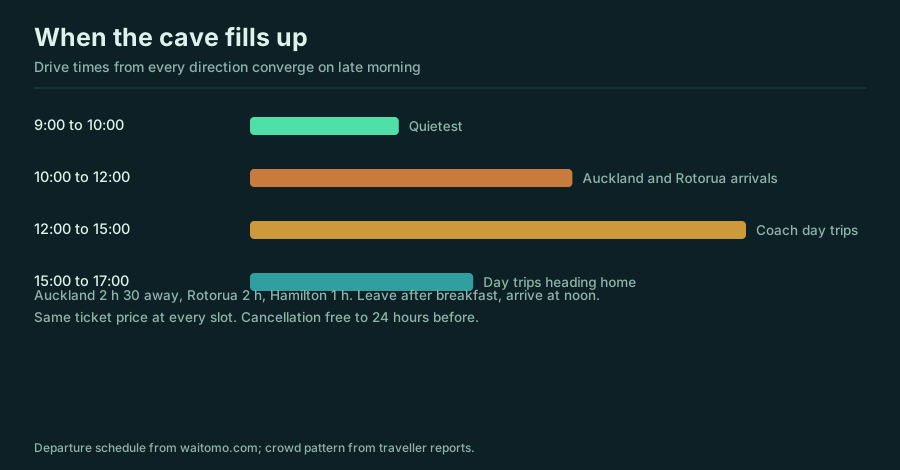
Where each kind of visitor tends to arrive from, and when that lands.
| Arriving from | Distance | Typical arrival |
|---|---|---|
| Auckland | 202 km, 2 h 30 | Late morning |
| Rotorua | 147 km, 2 h | Late morning |
| Hamilton | 71 km, 1 h | Mid-morning |
| Staying in the village | Walk | Any slot, including 9am |
What does a quiet tour actually change?
The boat, mainly. The Grotto section runs in silence and darkness, and the number of people in the boat with you is the difference between an intimate few minutes and a shared one. Reviewers who describe being moved by it are almost always describing a moment that felt private.
The walking section changes less. The guide gives the same commentary to twelve people as to twenty-three, and the Cathedral has the same acoustics either way. What a smaller group buys there is sightlines and the chance to actually ask something.
It does not change the length. The glowworm section is around five to ten minutes of the 45 regardless of who else is on the boat, which is the complaint that dominates every review platform and is not solved by timing.
Is the last tour of the day worth targeting?
Often, and it is the underrated slot. The final departures before the 5pm close are frequently calm, because day-trippers have started driving home and the coaches have gone. Nobody arrives at Waitomo at 4:30pm having driven from Auckland that morning.
There is a second, quieter argument for it. Carbon dioxide accumulates in the cave as groups pass through, which is why the site monitors it and manages numbers against a ceiling near 2,400 parts per million. The morning cave has had all night to settle. How that system works is a genuinely interesting piece of the operation.
On balance, first slot beats last slot: same quiet, better air, and your day is still ahead of you. But if a 9am departure means leaving a city at six, the late option is a real alternative rather than a consolation.
The two crowd variables stack, and only one of them is free to change.
| Quietest | Busiest | |
|---|---|---|
| Time of day | First and last departures | Midday to mid-afternoon |
| Time of year | May to September | December to February |
| Cost of choosing well | Nothing, same ticket | n/a |
What about the time of year?
A different question with the same answer: avoid the middle. December to February is the New Zealand summer school holiday peak and May to September is the quiet stretch. The glowworms are identical in both, because the colony lives in a cave holding a constant 16 °C and does not have a season.
So the crowd-avoidance strategy stacks. A 9am slot in June is a different experience from a 12:30 slot in January, for exactly the same price and exactly the same display. The full seasonal breakdown covers the months, and the guide to hours and departures has the schedule detail.
Booking a specific slot is the only lever, and it is free to pull: cancellation on the featured tour is free up to 24 hours before. The 45-minute guided cave tour lists every departure for your date, and you can check live availability and prices on GetYourGuide before you commit to a driving plan.
Does the same pattern apply to the other Waitomo tours?
Less so, because the other products do not run on a half-hourly cycle. Ruakuri's 90-minute format and the small-group tours' three-hour formats space themselves out naturally.
| Product | Departure pattern | Crowding sensitive to timing? |
|---|---|---|
| Glowworm Caves, 45 min | Every 30 minutes, 9am to 5pm | Yes, strongly |
| Ruakuri, 1 h 30 | Scheduled departures | Mildly |
| Aranui, 1 h | Scheduled departures | Mildly |
| Small-group cave tours, 3 h | Few, small | No, capped by design |
| Black Labyrinth rafting | Scheduled, gear-limited | No |
If crowds are the thing you are optimising against, the choice of product matters more than the choice of hour. A six-guest cave tour at noon is quieter than the flagship at 9am, and no amount of clever scheduling closes that gap.
What actually happens across a day at the visitor centre?
A predictable curve driven entirely by road distance, not by anything the operator does. Every arrival direction empties onto the same car park at roughly the same time.
| Time | Who is arriving | Feel |
|---|---|---|
| 9:00 to 10:00 | People who stayed nearby, early Hamilton departures | Calmest |
| 10:00 to 11:30 | Auckland and Rotorua self-drivers | Building |
| 11:30 to 14:30 | Coach day trips, plus everyone else | Peak |
| 14:30 to 16:00 | Late self-drivers, day trips heading home | Easing |
| 16:00 to 17:00 | Very few | Quiet again |
The curve is the reason a 9am slot and a 4pm slot deliver the same tour with a different atmosphere, at the same price, on the same ticket.
What time of day is quietest at the Waitomo caves?
The first departures of the morning, from 9am, and the last before the 5pm close. Coach traffic and independent drivers both converge on the middle of the day, which produces a predictable bulge between about noon and three.
How many people are on a tour?
Travellers report around 23, with tours running back to back through the busy hours. The operator does not publish a maximum. What it does publish is a departure every 30 minutes from 9am to 5pm, which tells you the site is built for throughput.
Does a quieter tour show more glowworms?
No. The display is the same, and so is the length of the boat section at around five to ten minutes of the 45. What changes is how the moment feels, and whether you can see past the person in front of you.
Is the last tour of the day a good option?
Often, yes. Day-trippers have left and the coaches have gone. The morning still edges it, because carbon dioxide accumulates in the cave through the day and the first slot enters air that has settled overnight, but the late option is a genuine alternative.
Can you choose your departure time when booking?
Yes, and it is the only real lever you have over how busy your tour is. Every slot for your date is shown at booking, and cancellation is free up to 24 hours before, so holding a specific early slot costs nothing.