Opening hours and departure times, 2026
Departures every 30 minutes from 9am to 5pm, daily. Which slots fill, how much buffer to leave, and what the half-hourly cycle means for how busy your tour is.
 Written with Hemi Williams, Waitomo cave guide and local specialist, guiding since 2015
Half-hourly departures sound like a convenience, and they are. They are also the single most useful fact about how busy your tour will be, because a cave that cycles a group every thirty minutes from nine until five is a cave with a rhythm, and the rhythm is not flat.
What time do the Waitomo caves open?
Nine in the morning until five in the afternoon, daily, with tours departing every 30 minutes across that window. That gives seventeen departure slots a day, and the tour itself runs 45 minutes, so departures overlap inside the cave.
The operator's own visitor information is the source to check before travelling, since public holidays and seasonal adjustments do occur. Nothing on this page substitutes for the listing for your specific date.
| Item | Detail |
|---|---|
| Opening hours | 9:00am to 5:00pm daily |
| Departure frequency | Every 30 minutes |
| Departures per day | 17 |
| Tour length | 45 minutes |
| Realistic time on site | ~90 minutes |
| Cave temperature | Constant 16 °C, any hour, any month |
How much time should you leave before your slot?
Fifteen minutes for the Glowworm Cave, thirty for Ruakuri or Aranui, which is what the operator itself recommends. The difference is not arbitrary: the other two caves need your own transport from the village, so the buffer covers the drive and the parking as well as the check-in.
There is a second reason for the buffer at the Glowworm Cave specifically. Nothing that takes a photograph goes past the entrance, so bags, phones and cameras all get left behind before you walk down. When a full group arrives at once, that handover takes longer than anyone expects.
| Cave | Recommended arrival before departure | Why |
|---|---|---|
| Waitomo Glowworm Caves | 15 minutes | Check-in plus leaving bags and cameras |
| Ruakuri Cave | 30 minutes | Own transport, separate site |
| Aranui Cave | 30 minutes | Own transport, separate site |
Which departure times are quietest?
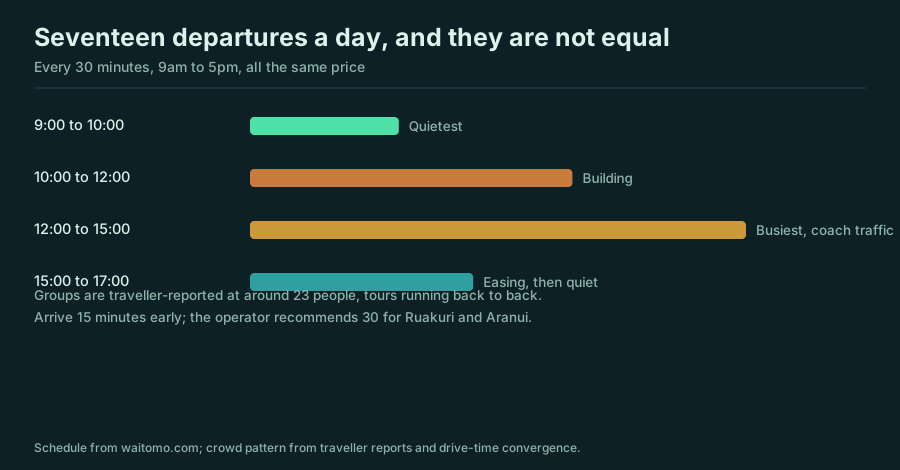
The first slots of the morning and the last of the afternoon. Coach traffic clusters around the middle of the day, and independent drivers who left a city after breakfast arrive in the same window. The 9:00 and 9:30 departures, and the last hour before five, are consistently reported as the calmer ones.
This matters because of group size. Travellers describe groups of around 23 people with tours running back to back through the busy hours. That figure is reported rather than published by the operator, but the half-hourly cycle is published, and it tells you the same thing: this is a cave designed to move people through steadily.
Booking a specific slot is the only lever you have, and it costs nothing to pull. The 45-minute guided cave tour lists every departure for your date, and you can check live availability and prices on GetYourGuide with free cancellation up to 24 hours before. More on how the day fills up goes through it hour by hour.
Do the caves close?
Not seasonally, and not for weather in the ordinary sense. The tour runs daily and the cave interior sits at 16 °C whatever is happening above ground. What can interrupt operations is the cave's own management: air quality is monitored continuously, and tours can stop if the carbon dioxide limit is reached.
Heavy rain raises the level of the Waitomo River, which flows through the cave and carries the boat. Prolonged wet weather can affect roads and walkways in the district. Neither is a routine closure, and neither is something to plan around, but both are reasons to check the operator's own updates if the forecast is severe. What happens when the river rises covers it in more detail.
How do the three caves' schedules interact?
They do not run in parallel in any useful way, which is why a two-cave day needs planning. The Glowworm Cave departs every half hour. Ruakuri runs 90-minute tours and Aranui hour-long ones, both at lower frequency, and both need a drive from the village.
| Cave | Length | Frequency | Transport from the village |
|---|---|---|---|
| Waitomo Glowworm Caves | 45 min | Every 30 minutes | Walk from the visitor centre |
| Ruakuri | 1 h 30 | Scheduled departures | Own vehicle |
| Aranui | 1 hour | Scheduled departures | Own vehicle |
The practical version: book the Glowworm Cave slot first, because it is the flexible one, then fit a Ruakuri or Aranui departure around it. Allow about three and a half hours on site for two caves. How long you need at Waitomo sets out the realistic shapes, and the comparison of the two main caves will tell you whether the second one is worth the afternoon.
How does the half-hourly cycle shape your visit?
Seventeen departures a day is a throughput design, and everything visitors notice about the tour follows from it. Group sizes, pacing, the guide moving people along at the Grotto, the sense that another tour is behind you: all of it is the schedule, not the staff.
| What the schedule produces | What visitors report |
|---|---|
| A departure every 30 minutes | Groups of around 23, back to back through the busy hours |
| A fixed 45-minute run time | The boat section kept short so the cycle holds |
| 500,000 visitors a year through one cave | Active air-quality management, CO2 capped near 2,400 ppm |
| Seventeen slots to choose between | Real control over how busy your own tour is |
That last row is the one to act on. The schedule is also the fix: nothing stops you taking the 9am, and it costs the same as the 12:30.
What are the other caves' schedules like?
Slower, fewer, and dependent on your car. Ruakuri runs 90-minute tours and Aranui hour-long ones, both at lower frequency than the Glowworm Cave, and the operator recommends arriving 30 minutes early for either because you have to drive there from the village.
| Cave | Length | Frequency | Arrive before | Transport |
|---|---|---|---|---|
| Waitomo Glowworm Caves | 45 min | Every 30 minutes | 15 min | Walk from the centre |
| Ruakuri | 1 h 30 | Scheduled departures | 30 min | Own vehicle |
| Aranui | 1 hour | Scheduled departures | 30 min | Own vehicle |
Build a two-cave day around the fixed thing rather than the flexible one: pick your Ruakuri or Aranui departure first, then slot the Glowworm Cave around it, since that one leaves every half hour and will fit almost anywhere.
What actually happens in the fifteen minutes before your tour?
More than people budget for, which is why 90 minutes on site is the honest figure for a 45-minute ticket. Check-in is the small part. The part that eats time is the entrance handover, because nothing that takes a photograph goes past the door.
| Step | Roughly | Note |
|---|---|---|
| Check in at the visitor centre | 5 min | Cashless site |
| Leave bags, phones and cameras | 5 to 10 min | Slower when a full group arrives at once |
| Walk to the cave entrance | A few minutes | Formed path |
| The tour | 45 min | Stairs throughout, 16 °C |
| Return through the centre | 5 to 10 min | Souvenir photo desk sits on the way out |
Arriving with your phone already in the car rather than in your pocket genuinely speeds this up, which sounds trivial until you are behind twenty people doing it at the shelf.
Does the site close on public holidays?
Not something we will state either way, because the operator is the only reliable source for a specific date and holiday hours are exactly the kind of detail that changes without notice. What we can say is that the published pattern is daily operation from 9am to 5pm with departures every 30 minutes, and that pattern has been stable.
The dates worth checking directly rather than assuming are Christmas Day, Good Friday, Anzac Day morning and any regional anniversary day, because New Zealand attractions vary widely on all four. The operator's own visitor information is the page to look at, and the booking platform will simply not offer a slot that is not running.
| If you are visiting on | Do this |
|---|---|
| An ordinary weekday | Book any slot; the schedule is stable |
| A weekend in peak season | Book well ahead; slots fill |
| A New Zealand public holiday | Check the operator, then book |
| Christmas or Easter | Check the operator before planning the day around it |
The booking platform is a useful proxy here. If a date shows no availability at all rather than sold-out slots, that is usually the answer.
How does the schedule interact with the drive?
Badly, if you book the slot before you check the drive. Every arrival direction converges on late morning, which is exactly the window most people instinctively book.
| Leaving | Arriving at Waitomo | Sensible slot |
|---|---|---|
| Auckland at 7am | ~9:30 | 9:30 or 10:00 |
| Auckland at 9am | ~11:30 | Accept a busy slot, or take a late one |
| Hamilton at 8am | ~9:00 | 9:00, the quietest of the day |
| Rotorua at 8am | ~10:00 | 10:00, still ahead of the coaches |
| Staying in the village | Walk | 9:00 |
The pattern to avoid is booking a convenient-sounding midday departure and then discovering that convenient-sounding is what everyone else booked too. Working backwards from the drive rather than forwards from the clock lands you in a quieter cave for the same money.
What time do the Waitomo Glowworm Caves open?
Nine in the morning until five in the afternoon, daily, with tours departing every 30 minutes across that window. Check the operator's own information for your specific date, since public holidays and seasonal adjustments do happen.
How often do tours leave?
Every 30 minutes, which gives seventeen departures a day. The tour runs 45 minutes, so groups overlap inside the cave. That cycle is the reason the middle of the day feels busy and the first and last slots do not.
How early should you arrive?
Fifteen minutes for the Glowworm Cave. The operator recommends thirty for Ruakuri and Aranui, which need your own transport from the village. The extra time at the Glowworm Cave covers leaving bags, phones and cameras at the entrance, since none of them are allowed inside.
Is there a last tour of the day?
The final departures run up to the 5pm closing time, and they are consistently among the quieter slots. Booking one is a straightforward way to avoid the middle-of-the-day coach traffic without changing anything else about your plans.
Do the caves ever close?
Not seasonally. The cave holds 16 °C year round and tours run daily. Operations can be interrupted by the site's own air-quality management, which caps carbon dioxide around 2,400 ppm, and severe weather can affect roads and river levels in the district.